01
Museum · the essential stop
The Musée de l’École de Nancy
One of the few French museums devoted to Art Nouveau: furniture, glassware, ceramics and stained glass by the Nancy masters, set in a villa with a garden.
At the end of the 19th century, Nancy became one of the world capitals of Art Nouveau.
In 1901, Émile Gallé brought the city’s artists together within the École de Nancy — the “Provincial Alliance of Art Industries”. Glass, furniture, wrought iron, stained glass, architecture: drawing inspiration from nature — flowers, insects, plant-like lines — Gallé, Majorelle, the Daum brothers, Grüber and Prouvé reinvented the decorative arts.
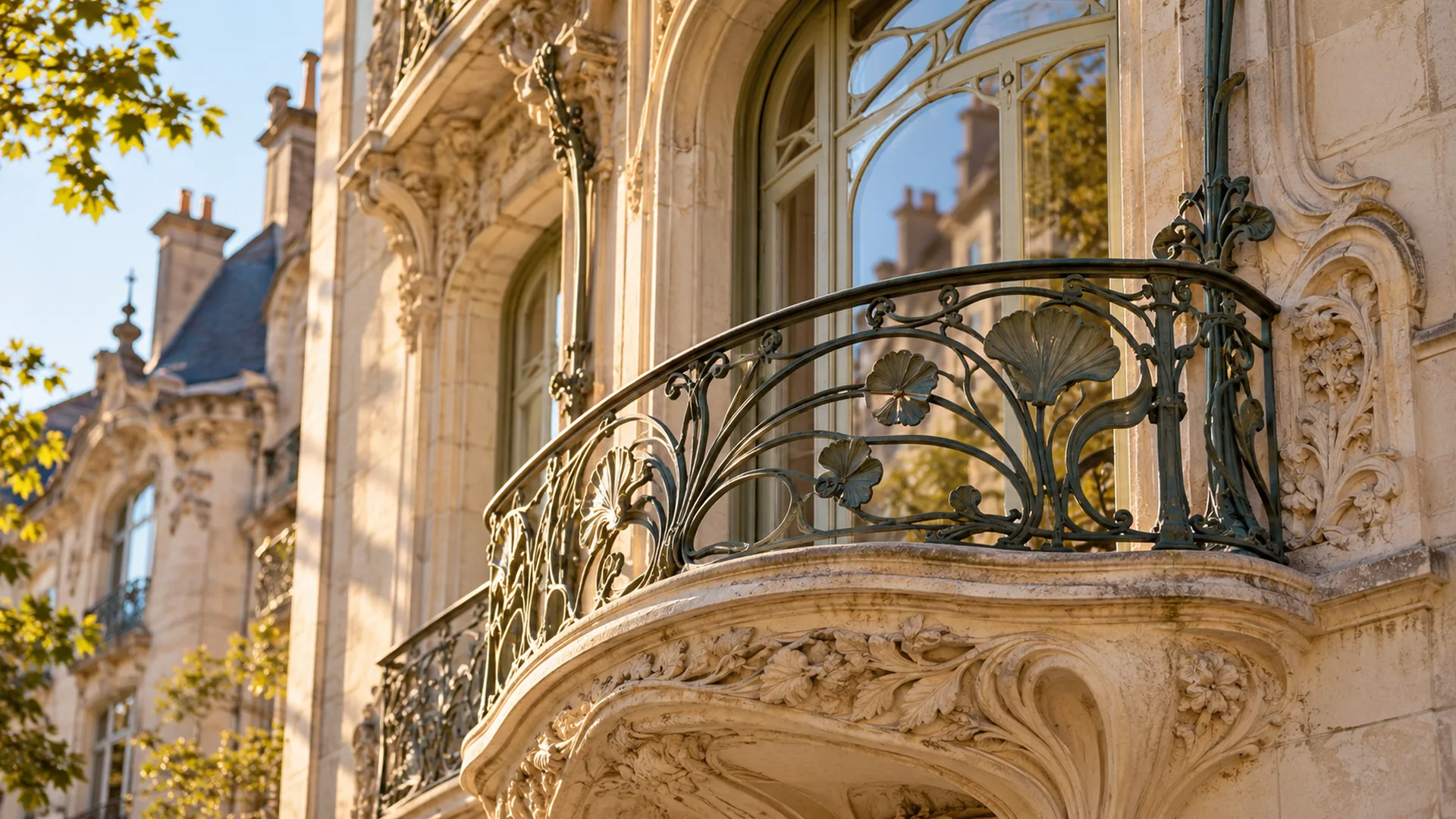
A century on, the city preserves a unique heritage: dedicated museums, manifesto villas, and a thousand details along its streets — a shopfront, a railing, a stained-glass window. Here is where to find it.
One of the few French museums devoted to Art Nouveau: furniture, glassware, ceramics and stained glass by the Nancy masters, set in a villa with a garden.
The first Art Nouveau house in Nancy, home and studio of Louis Majorelle: restored period interiors, wrought ironwork and stained glass.
On the Place Stanislas, a basement holding an exceptional collection of Daum glassware, from Art Nouveau to Art Deco.
A 1908 building adorned with wrought ironwork by Louis Majorelle and stained glass by Jacques Grüber and Antonin Daum.
An Art Nouveau gem listed as a Monument historique: woodwork by Majorelle, stained glass by Grüber and stucco — best admired from the dining room, over a seafood platter.
A private residence by the architect Lucien Weissenburger, with wrought ironwork by Majorelle and stained glass by Grüber (visible from the outside).
A 1907-1910 building by Émile André, with a bold concrete frame and a regionalist silhouette (now BNP Paribas).
One of the best-preserved villas in the Art Nouveau garden city of the Parc de Saurupt (1902-1904).
A row of colourful houses with naturalist decoration (1903-1913), including no. 36 designed by Émile André.
A former department store of 1901 whose mahogany shopfront was a work by Eugène Vallin and Émile André.
A shop of 1900-1901 by Henri Gutton, the first metal-framed building in Nancy, with floral decoration by Grüber.
The tourist office offers a signposted Art Nouveau trail linking several of these addresses — perfect for a half-day of wandering.
Glassmaker, cabinetmaker and ceramist — founder and soul of the École de Nancy (1901).
Cabinetmaker and art metalworker — some of the most celebrated furniture, banisters, railings and light fittings.
Master glassmakers — engraved multi-layered glassware and pâte de verre pieces.
Master glassmaker — the great Art Nouveau stained-glass windows of Nancy (Excelsior, CCI, Génin-Louis).
Painter, sculptor and decorator — Gallé’s successor at the head of the École de Nancy.
Cabinetmaker and interior architect — furniture and shopfronts with plant-like lines.
Architect — designer of the Villa Majorelle, the city’s first Art Nouveau house.
A leading architect of Nancy’s Art Nouveau (Maison Bergeret, Excelsior).